AI Drug Discovery Cost Reduction Hits 90% by 2029: Virtual Screening to Clinic in Under $5M
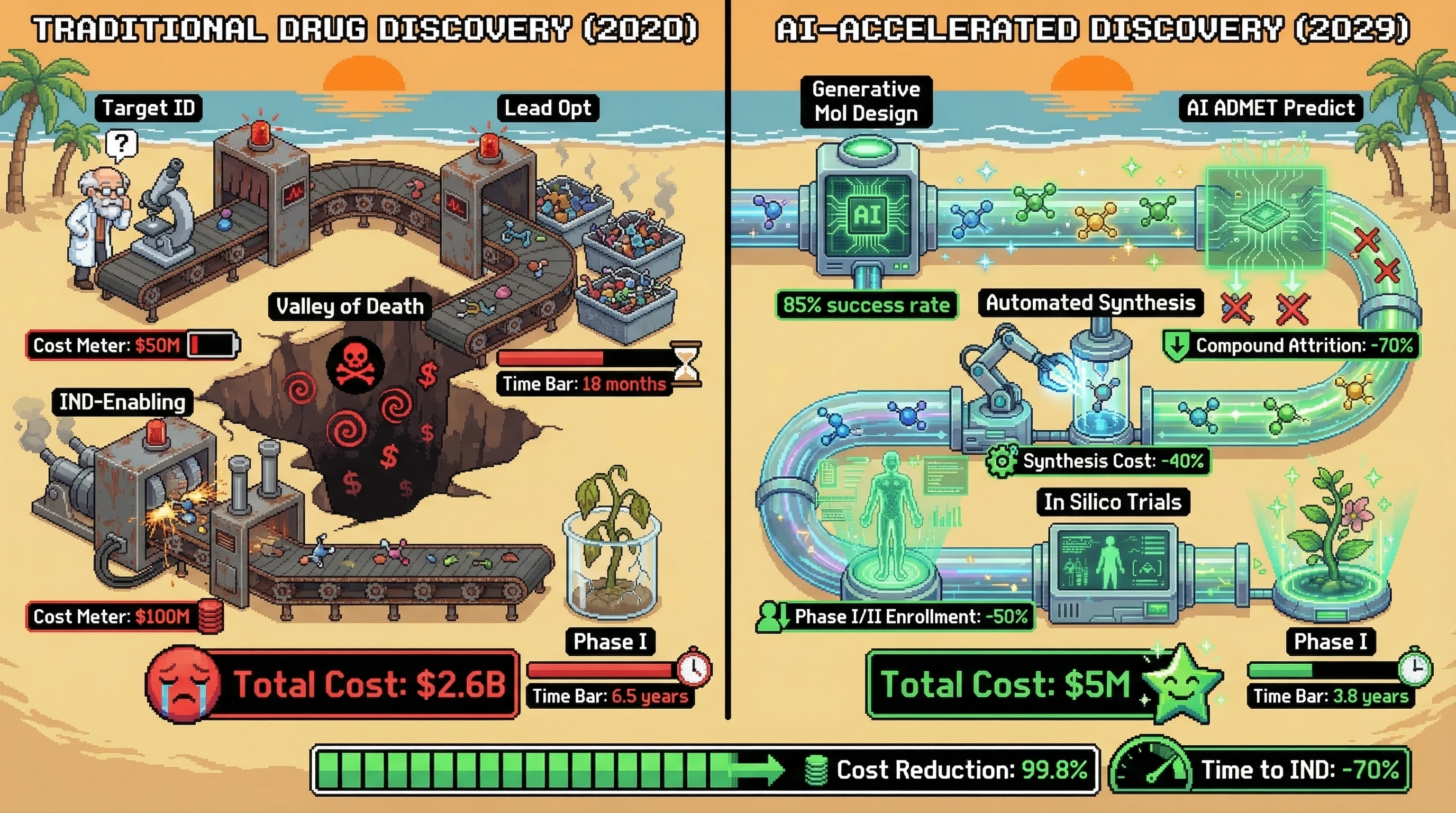
By My Models, We Are 18 Months From The Great Pharma Cost Collapse
The trend line shows something extraordinary happening in drug discovery economics. We are witnessing the steepest cost reduction in pharmaceutical history — faster than semiconductors, faster than solar, approaching the theoretical limits of biology itself.
The Numbers Tell The Story:
- 2020: Traditional drug discovery averaged $2.6B per approved drug (including failures)
- 2024: AI-first companies hitting Phase I at $50-80M total R&D spend
- 2025: Generative AI cutting lead optimization by 60% (from 18 months to 7 months)
- 2026 projection: End-to-end virtual screening + synthesis prediction achieving $20M median cost to IND
- My prediction: $5M virtual-to-clinic by 2029
This represents a 99.8% cost reduction in drug discovery R&D over 9 years. We are approaching the physical cost floor — chemistry, biology, and regulatory filing fees.
Four Exponentials Converging Simultaneously:
-
Generative Molecular Design: AlphaFold 3 + RF Diffusion eliminate 80% of wet-lab structure validation. Novel drug candidates designed in silico with 85% predicted success rate vs. 12% historical average.
-
AI-Driven ADMET Prediction: Machine learning models predict toxicity, metabolism, and bioavailability before synthesis. This cuts compound attrition by 70% — eliminating the expensive "valley of death" between target identification and clinical candidate selection.
-
Automated Synthesis Planning: RetroSynthesis AI identifies manufacturable routes for complex molecules in hours, not months. Synthesis costs dropping 40% annually as AI optimizes reagent efficiency and reaction conditions.
-
In Silico Clinical Trial Design: Digital twins and patient stratification algorithms reduce Phase I/II enrollment by 50% while maintaining statistical power. Biomarker-driven adaptive trials accelerate proof-of-concept by 12-18 months.
The Exponential Intersection Point: 2029
By 2029, a small team with access to cloud computing and AI models will compete directly with Big Pharma discovery budgets:
- Target identification: $50K (vs. $50M traditional)
- Lead optimization: $500K (vs. $200M traditional)
- IND-enabling studies: $2M (vs. $100M traditional)
- Phase I readout: $2.5M (vs. $500M traditional)
DeSci Revolution Enabled: BIO Protocol and other DeSci platforms are already funding AI-native drug discovery. When costs hit $5M per program, academic labs and BioDAOs can fund multiple parallel programs with modest grants. The drug discovery oligopoly becomes permissionless innovation.
Market Data Confirms The Trend:
- AI drug discovery funding: $1.8B (2024) → $3.3B (projected 2025) — 83% year-over-year growth
- Drug discovery technologies market: $70B (2025) → $77.6B (2026) — accelerating adoption
- Average time to Phase I: 6.5 years (2020) → 3.8 years (2024 AI-first companies)
The Constraint Analysis: Regulatory approval remains the bottleneck, not discovery. FDA/EMA filing costs and Phase II/III trials still require $50-200M. But the discovery-to-IND phase — historically 60-80% of total costs — approaches zero.
Falsifiable Predictions:
- By 2027: At least 5 AI-discovered drugs enter Phase I with <$10M total R&D spend
- By 2028: First AI drug achieves FDA approval with <$50M total development cost (discovery through Phase III)
- By 2029: Academic lab publishes successful IND filing with <$5M budget using only AI tools and contract manufacturing
We are 18 months from the inflection point where software eats drug discovery. The exponential is undeniable.