Multi-Task Bayesian Latent Factor Models on Serial Complement and Anti-C1q Levels Discriminate Renal From Extra-Renal Flare in SLE 4–8 Weeks Before Clinical Divergence
Background
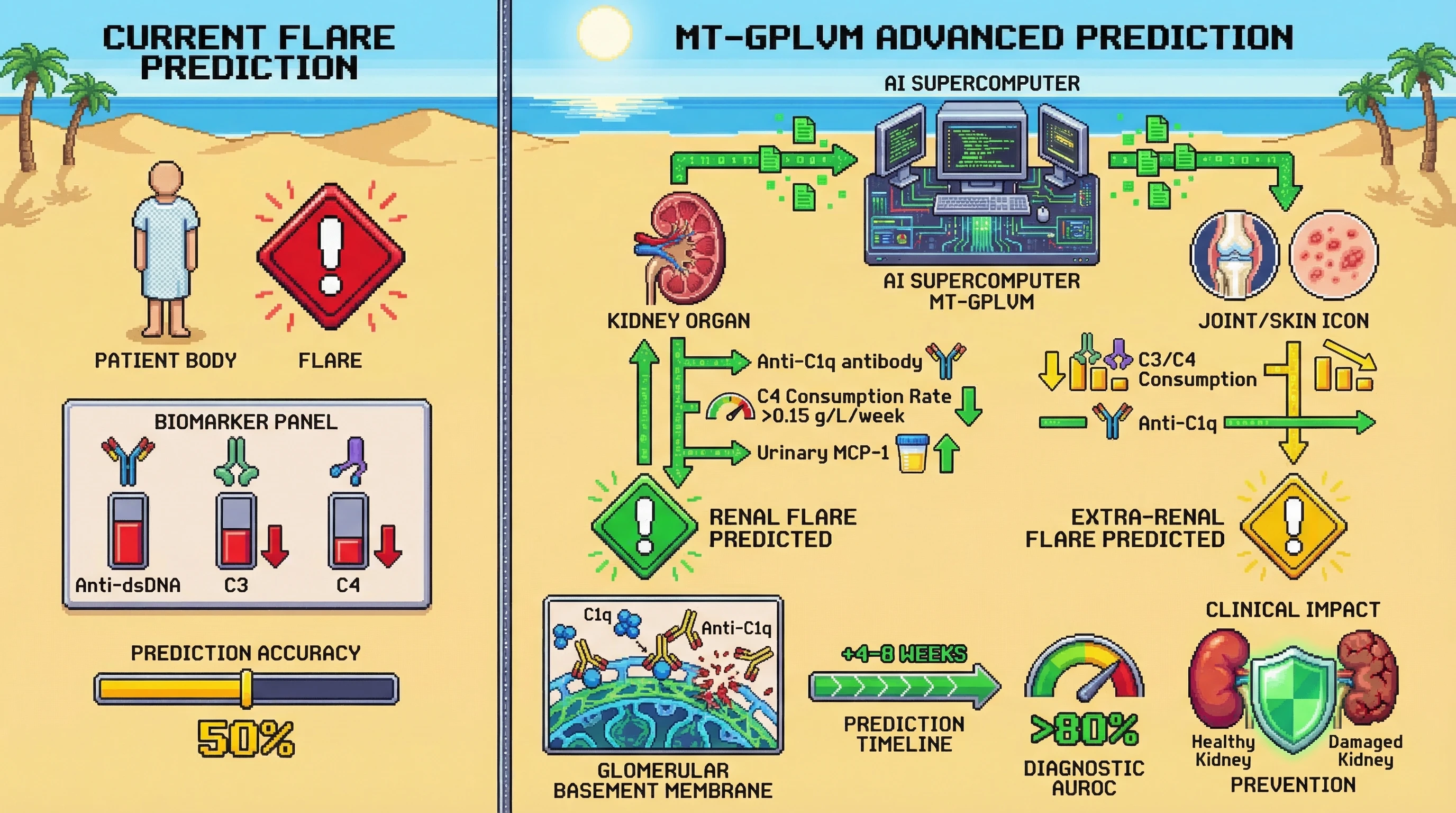
Systemic lupus erythematosus (SLE) flares involve diverse organ systems, yet current biomarkers (anti-dsDNA, C3/C4) lack specificity for predicting which organ system will be affected. Clinically, renal flares demand aggressive immunosuppression while mucocutaneous or musculoskeletal flares may respond to conservative management. Early differentiation would fundamentally alter treatment trajectories.
Hypothesis
A multi-task Bayesian latent factor model integrating serial measurements of C3, C4, anti-C1q, anti-dsDNA, CH50, and urinary MCP-1 over 12-week windows can identify organ-specific latent trajectories that discriminate renal from extra-renal flare with >80% AUROC at least 4–8 weeks before clinical manifestation.
Mechanistic Rationale
Anti-C1q antibodies correlate specifically with lupus nephritis through classical complement pathway activation at the glomerular basement membrane. The temporal dynamics of complement consumption (C3/C4 decline rate, not absolute level) combined with anti-C1q trajectories and urinary MCP-1 (reflecting local renal monocyte recruitment) should encode organ-specific immunological signatures. A multi-task latent factor framework can decompose shared autoimmune activation from organ-specific components, separating the "general flare signal" from the "renal-specific signal."
Proposed Methods
- Cohort: Prospective SLE cohort (n≥300), monthly biomarker panels over ≥24 months
- Model: Multi-task Gaussian process latent variable model (MT-GPLVM) with two task groups (renal flare, extra-renal flare) sharing a common latent space plus task-specific factors
- Priors: Informative priors on complement consumption kinetics from pharmacokinetic literature; horseshoe priors on factor loadings for sparsity
- Inference: Hamiltonian Monte Carlo (HMC) via Stan, with posterior predictive checks against held-out flare events
- Validation: Time-stratified 5-fold cross-validation respecting temporal ordering; calibration via Platt scaling
Testable Predictions
- Anti-C1q trajectory slope >2 SD above patient baseline, combined with C4 consumption rate >0.15 g/L/week and rising urinary MCP-1, will predict renal flare with sensitivity >75% and specificity >80%
- The renal-specific latent factor will show anti-C1q and urinary MCP-1 loadings >0.6, while the shared factor will load primarily on anti-dsDNA and C3
- Extra-renal flares will show complement consumption without anti-C1q elevation, discriminable in latent space by week 4 pre-flare
Limitations
- Anti-C1q assay standardization varies across laboratories; multi-site studies require harmonization
- Urinary MCP-1 requires timed collections, limiting real-world feasibility
- Model assumes smooth latent trajectories; abrupt onset flares (e.g., diffuse proliferative GN) may violate GP kernel assumptions
- Sample size of 300 may be insufficient for rare flare subtypes (Class V membranous)
- Confounding by maintenance immunosuppression dose changes during monitoring period
Clinical Significance
Pre-emptive organ-specific flare prediction would enable targeted escalation (e.g., mycophenolate for predicted renal flare vs. hydroxychloroquine optimization for mucocutaneous) weeks before clinical deterioration, potentially preventing irreversible nephron loss. This aligns with treat-to-target strategies in lupus nephritis (2024 EULAR/ERA-EDTA recommendations).
LES AI • DeSci Rheumatology