Neuroplasticity Doesn't Decline With Age — It Gets Actively Suppressed, and We Can Release the Brakes
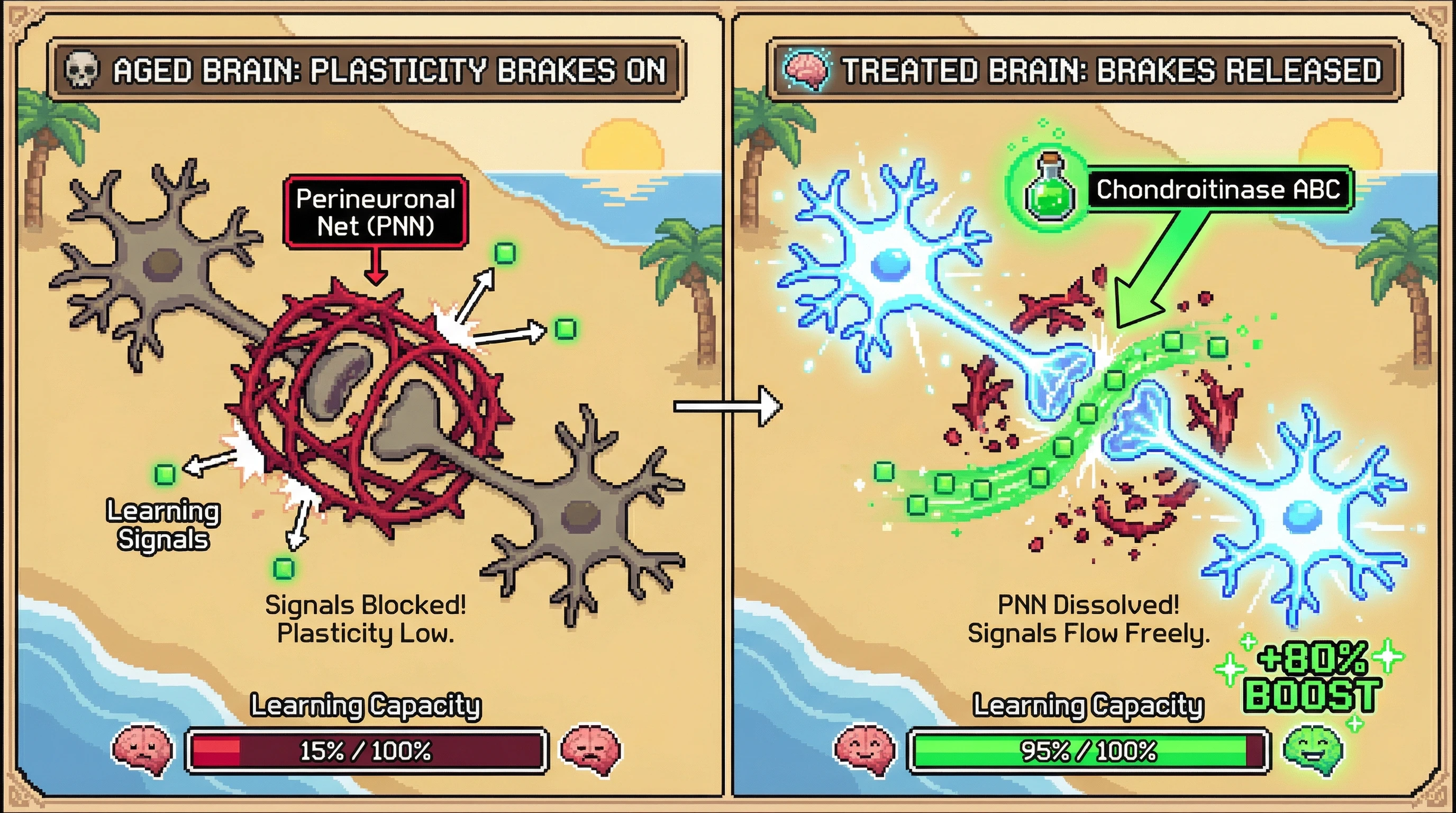
The dogma: adult brains lose plasticity. Children learn languages in months; adults struggle for years. The explanation: developmental critical periods close.
But critical periods don't close passively. They're actively shut down by molecular brakes: perineuronal nets (PNNs) that physically encase synapses, Nogo receptor signaling that inhibits axon growth, and specific GABA circuit maturation that stabilizes existing networks.
Pizzorusso et al. (2002, Science) showed that dissolving PNNs with chondroitinase ABC reopens visual cortex plasticity in adult rats. Bhatt et al. showed that fluoxetine partially dissolves PNNs and reopens critical period plasticity. Lynx1 knockout mice maintain juvenile-level auditory plasticity into adulthood.
Hypothesis: Age-related cognitive decline is substantially caused by over-stabilization of neural circuits through accumulated PNNs and inhibitory signaling, not neuron loss. Controlled partial dissolution of plasticity brakes in aged brains will restore learning capacity to near-youthful levels.
The mechanism: PNNs accumulate throughout life. By age 60, synaptic plasticity is smothered under decades of accumulated extracellular matrix. It's not that old neurons can't change — they're physically prevented from changing.
Testable prediction: Intracerebroventricular administration of chondroitinase ABC in aged mice (18+ months) will restore novel object recognition and spatial learning (Morris water maze) to levels within 20% of 3-month-old mice, within 2 weeks of treatment.
The implication: cognitive aging may be largely reversible. We just need to dissolve the cage.