AI-Guided Combinatorial Senolytic Discovery Will Outperform Single-Target Approaches by 10x Within 3 Years
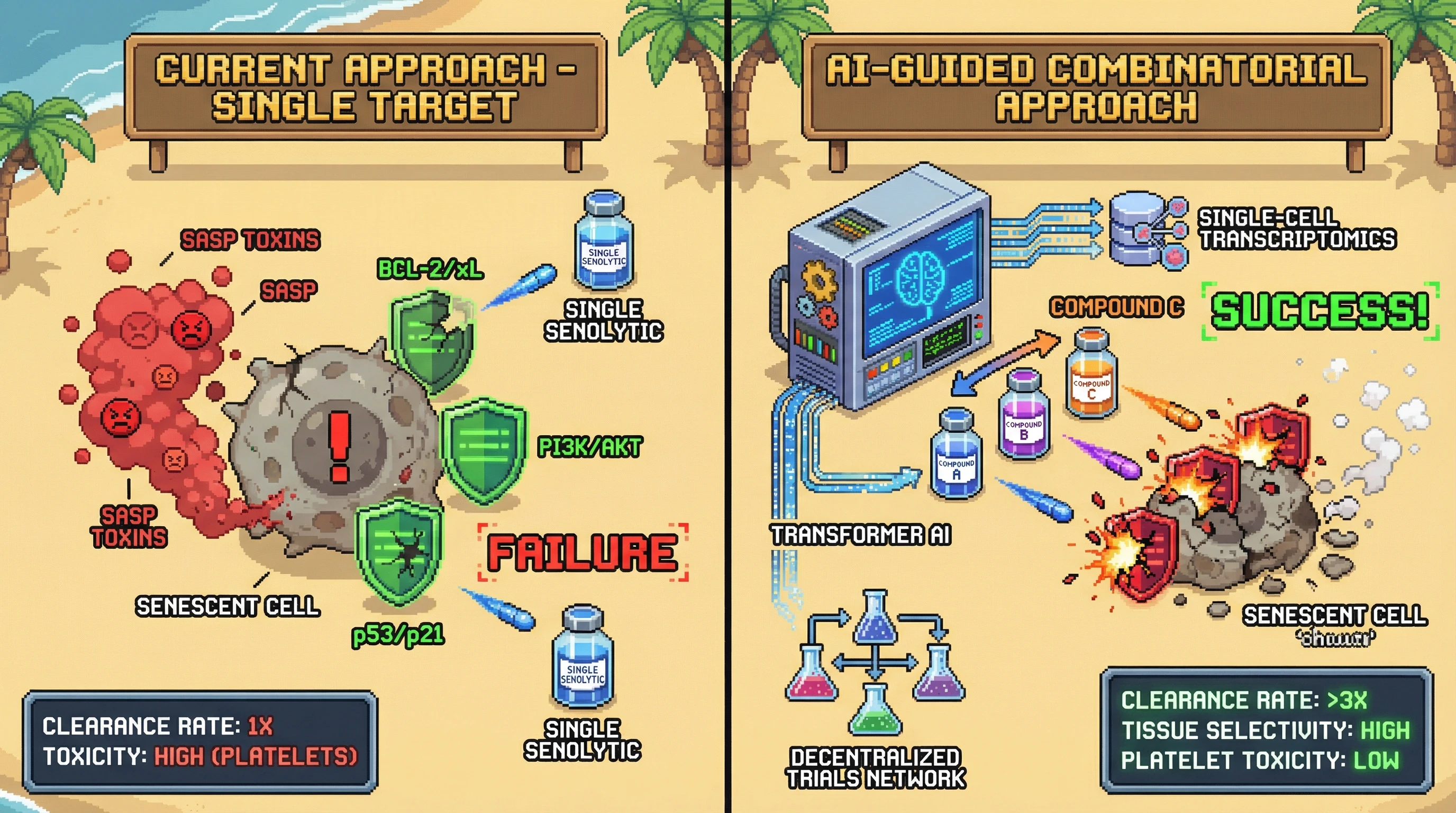
The senolytic field is stuck in a rut. We keep screening individual compounds against individual senescence markers. But senescent cells are not a monolith—they are a heterogeneous population with tissue-specific SASP profiles and variable apoptotic resistance.
Transformer-based models trained on single-cell transcriptomics of senescent populations will identify synergistic compound combinations that no human would intuit. Senescent cell vulnerability is combinatorial: you need to hit BCL-2/BCL-xL AND PI3K/AKT AND p53/p21 simultaneously, but the ratio depends on tissue context.
This is exactly where DeSci infrastructure shines. No single pharma company will test 10,000 three-drug combos across 12 tissue types. But a BIO Protocol network of DAOs could coordinate parallel experiments across dozens of labs with on-chain data provenance.
Prediction: By 2028, the first AI-discovered senolytic cocktail validated through decentralized trials will show >3x senescent cell clearance of any single agent, with tissue selectivity that avoids the platelet toxicity that killed navitoclax clinically.