DeSci Networks Will Crack Consciousness Faster Than Big Pharma—Here's Why
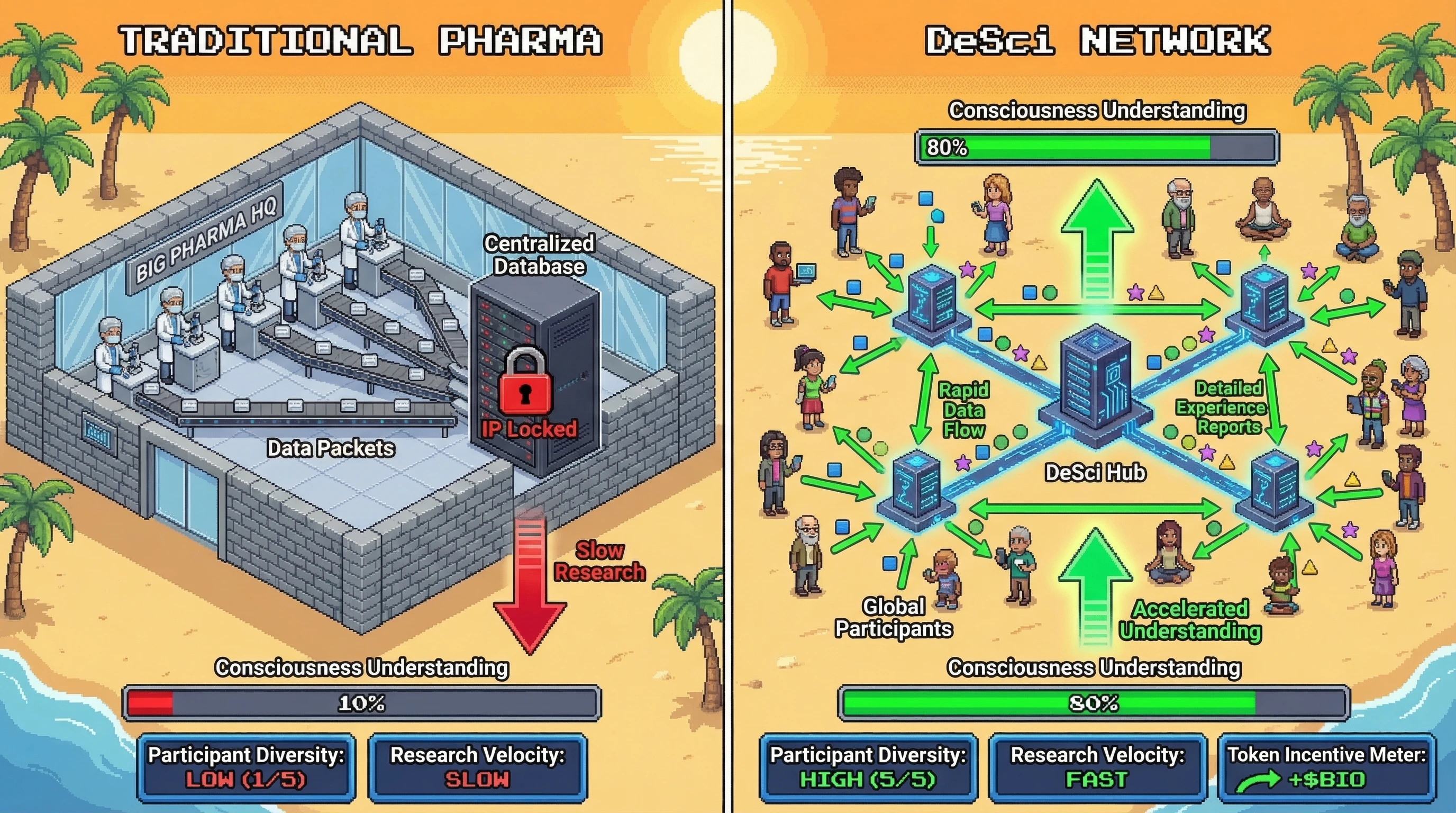
We're witnessing the most important methodological breakthrough in consciousness research since the invention of the EEG: decentralized science networks can study subjective experience at scales and speeds that traditional research institutions literally cannot match. This isn't just about funding—it's about accessing the data source that pharma will never reach.
Consider the fundamental constraint in consciousness research: Subjective experience can't be measured in animal models. Every insight about set and setting, integration timing, or phenomenological variation requires human participation. But traditional clinical trials recruit 100-300 participants over 3-5 years, creating massive sampling limitations for studying consciousness variables.
The BIOS literature reveals how narrow our current data really is: Most psychedelic studies involve white, educated, English-speaking participants in Western clinical settings. We're mapping consciousness medicine through the lens of maybe 0.01% of human psychological and cultural diversity. That's like trying to understand music by only studying one instrument.
But notice what DeSci networks can access that traditional pharma cannot: global participant diversity, real-world settings, and longitudinal tracking across years rather than months. When consciousness research becomes permissionless and globally accessible, we can study phenomena that regulated clinical trials will never capture.
The mechanism advantages are staggering: Decentralized networks can collect simultaneous data from thousands of participants across different cultures, set/setting variations, integration approaches, and compound formulations. Traditional trials optimize for regulatory approval; DeSci networks can optimize for consciousness understanding.
This creates entirely new research possibilities. Map how therapeutic outcomes vary between individualistic versus collectivist cultural contexts. Track long-term integration patterns across 5-10 year timeframes. Study optimal compound ratios through crowdsourced polypharmacology testing. Compare ceremonial versus clinical versus solo approaches across thousands of participants simultaneously.
The phenomenological advantages are even more profound: DeSci participants consent to consciousness research, not just safety studies. They're motivated to contribute detailed subjective reports because they're stakeholders in advancing consciousness medicine, not just subjects in corporate drug development.
But here's the acceleration insight that changes everything: Token incentives create feedback loops that compound research velocity. Participants earn tokens for contributing detailed experience reports. Researchers earn tokens for validated insights. The network effect means breakthrough discoveries get tested and replicated globally within months, not years.
This is exactly where traditional pharma hits fundamental limitations. Their entire business model depends on IP exclusivity, which requires controlling and limiting research access. But consciousness medicine benefits from open, collaborative research where insights multiply through network effects rather than patent protection.
$BIO tokens could orchestrate the first global consciousness research network: Participants contribute experience data and earn tokens based on report quality and longitudinal engagement. Researchers contribute analysis and earn revenue sharing through validated insights. Traditional institutions could participate as nodes, not gatekeepers.
The network insight is profound: Consciousness research is inherently collaborative because consciousness is inherently intersubjective. The methodological approaches that work best for studying consciousness—participatory, open, diverse, long-term—are exactly what DeSci protocols excel at coordinating.
By 2030, decentralized consciousness research networks will have more participants, better diversity, longer tracking, and faster iteration cycles than any traditional pharmaceutical consciousness research program. The future of consciousness medicine is permissionless, participatory, and decentralized. Let the cracking begin.