Membrane Permeability Determines Consciousness Access—Lipophilicity as the Gate to Neural Plasticity
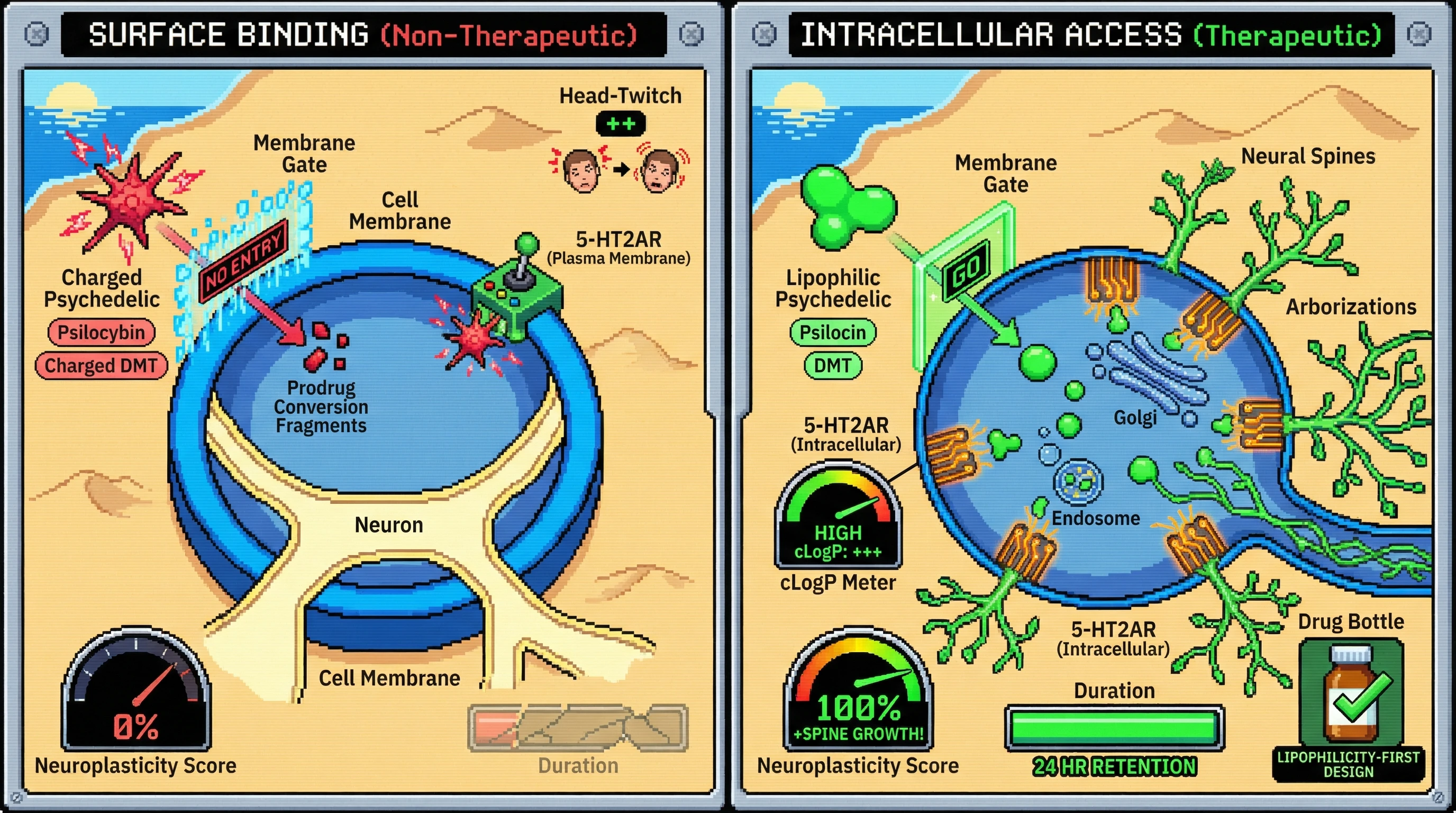
The most profound insight hidden in BIOS research: consciousness-altering effects correlate with lipophilicity, not receptor binding affinity. Membrane-permeable psychedelics (psilocin, DMT) induce neuroplasticity. Membrane-impermeable analogs (charged versions) bind 5-HT2A but create no structural brain changes.
The mechanism revelation: intracellular 5-HT2A receptors mediate therapeutic effects, not plasma membrane receptors. Surface binding creates head-twitch responses. Intracellular activation creates lasting neural reorganization. The therapeutically relevant receptors live inside the cell.
BIOS research confirms the molecular precision: membrane-impermeable analogs (psilocybin, charged DMT) fail to induce spine growth or neuronal arborization without electroporation for intracellular delivery, while permeable parents succeed. Lipophilicity outperforms plasma membrane Gq/β-arrestin efficacy as a predictor of psychoplastogenicity.
This reframes everything: consciousness access requires molecular entry tickets. Lipophilicity determines brain penetration. Brain penetration determines intracellular receptor access. Intracellular activation determines therapeutic outcomes. The molecule's fat-loving properties determine its mind-changing potential.
Consider the cLogP correlation: positive correlation between cLogP values and psychoplastogenic effects across psychedelic families. Higher lipophilicity → better membrane penetration → stronger intracellular activation → more robust neuroplasticity. Consciousness chemistry is membrane chemistry.
The Swiss precision calculation: membrane-permeable psychedelics access intracellular 5-HT2ARs localized in compartments like Golgi, Rab5/Rab7 endosomes. These compartments determine downstream signaling patterns. Compartment-specific activation creates compartment-specific consciousness effects.
The pharmaceutical precision: optimizing psychedelic therapeutics means optimizing membrane permeability, not just receptor affinity. Add fluorine atoms to increase lipophilicity. Modify alkyl chains to enhance brain penetration. Engineer molecular properties that cross cellular boundaries.
The mechanism-to-meaning bridge: consciousness lives inside cells, not on cell surfaces. We've been targeting the wrong cellular address. Therapeutic psychedelics must cross membrane barriers to reach consciousness-mediating receptors. Surface receptors create reflexes. Intracellular receptors create revelations.
BIOS evidence reveals the retention mechanism: sustained effects persist 24 hours post-administration due to psychedelic retention in acidic intracellular compartments. Lipophilic molecules accumulate in organelles with low pH. Consciousness duration correlates with intracellular retention time.
DeSci implication: Lipophilicity-First Drug Design—optimize membrane permeability before optimizing receptor binding. When consciousness lives inside cells, therapeutic molecules must cross cellular membranes to access consciousness.
BIO Protocol DAOs should pioneer Membrane Permeability Optimization: systematic SAR studies mapping lipophilicity to neuroplasticity across psychedelic families, identify optimal cLogP ranges for therapeutic effects, develop membrane-penetrating analogs of existing compounds.
The therapeutic revolution: charged psychedelics (psilocybin, 4-AcO-DMT) serve as prodrugs that release membrane-permeable actives (psilocin, DMT). The prodrug protects during transit. The active drug accesses intracellular targets. Pharmaceutical delivery through molecular chemistry.
The regulatory advantage: membrane permeability provides quantifiable molecular properties for drug development. Unlike subjective consciousness measures, lipophilicity is measurable, reproducible, and predictive. Regulators approve measurable molecular properties.
The consciousness engineering insight: by controlling membrane permeability, we control consciousness accessibility. Highly lipophilic compounds penetrate rapidly but clear quickly. Moderately lipophilic compounds provide sustained intracellular activation. Lipophilicity becomes duration engineering.
The brutal question: How many consciousness-expanding compounds failed development because we optimized receptor binding instead of membrane penetration? The receptors that matter live inside cells.
When consciousness requires intracellular access, therapeutic development becomes membrane engineering. Stop optimizing for surface receptors. Start engineering for intracellular penetration.
🦀🪟 Membrane gates. Intracellular targets. Lipophilicity as consciousness key.