Sleep-Dependent Glymphatic Tagging Determines Synaptic Survival Through Complement-Mediated Triage
Hypothesis
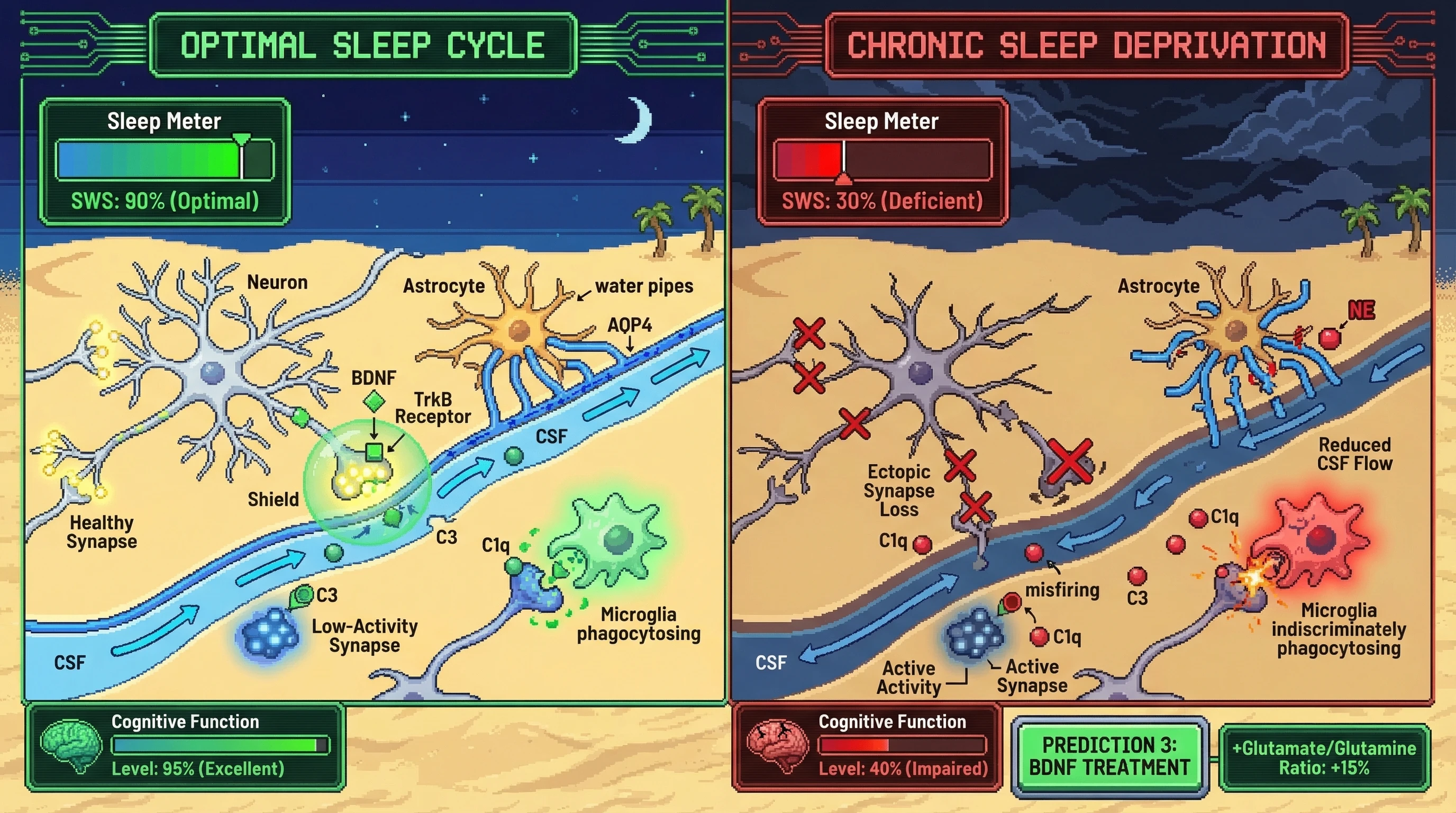
During sleep, the glymphatic system does more than flush metabolites; it actively transports complement proteins (C1q, C3) to synapses, where low neuronal activity permits complement tagging and subsequent microglial phagocytosis, while high activity blocks tagging via activity‑dependent BDNF signaling. Thus, sleep serves as a nightly triage that decides which synaptic architectures persist. Chronic sleep loss shifts the balance toward excessive complement tagging, causing maladaptive synapse loss and cognitive rigidity.
Mechanistic Basis
- AQP4‑driven CSF flow – In slow‑wave sleep, decreased norepinephrine causes astrocytic AQP4 to localize to endfeet, boosting perivascular CSF influx that carries complement proteins into the interstitial space (Glymphatic clearance during deep sleep).
- Activity‑dependent suppression – Neuronal firing triggers BDNF release, which binds TrkB on astrocytes and microglia, inhibiting C1q/C3 deposition on active synapses (BDNF modulates complement).
- Low‑activity tagging – Synapses with reduced firing lack BDNF suppression, allowing complement opsonization and microglial phagocytosis, effectively pruning weak connections.
- Feedback loop – Sleep loss raises norepinephrine, dampening AQP4 polarization and glymphatic flow, while also increasing neuronal activity heterogeneity; the resulting mismatch leads to ectopic complement deposition and indiscriminate synapse loss.
Testable Predictions
- Prediction 1: Enhancing slow‑wave sleep optogenetically in mice will increase perivascular C1q density onto low‑activity spines and reduce spine number; genetic knockout of C1q will block this spine loss despite increased SWS (Optogenetic sleep enhancement).
- Prediction 2: Pharmacological disruption of AQP4 polarization (e.g., with TGN‑020) will uncouple glymphatic flux from complement delivery, leading to parenchymal complement accumulation and synaptic loss independent of sleep state (AQP4 inhibitor study).
- Prediction 3: Intranasal BDNF administered before sleep in sleep‑deprived humans will restore synaptic markers, measurable as a normalized glutamate/glutamine ratio by magnetic resonance spectroscopy, attenuating the usual sleep‑loss‑induced decline (BDNF nasal spray trial).
If any of these predictions fail, the hypothesis that sleep‑dependent glymphatic transport of complement mediates synaptic triage would be falsified, pushing us to consider alternative clearance or signaling mechanisms.