Synthetic biology hits the $1 per engineered protein threshold by 2027 — biology becomes programmable hardware
The cost curve for engineering biological systems is experiencing its steepest descent in history. We are approaching a threshold where biological components become cheaper than their electronic equivalents.
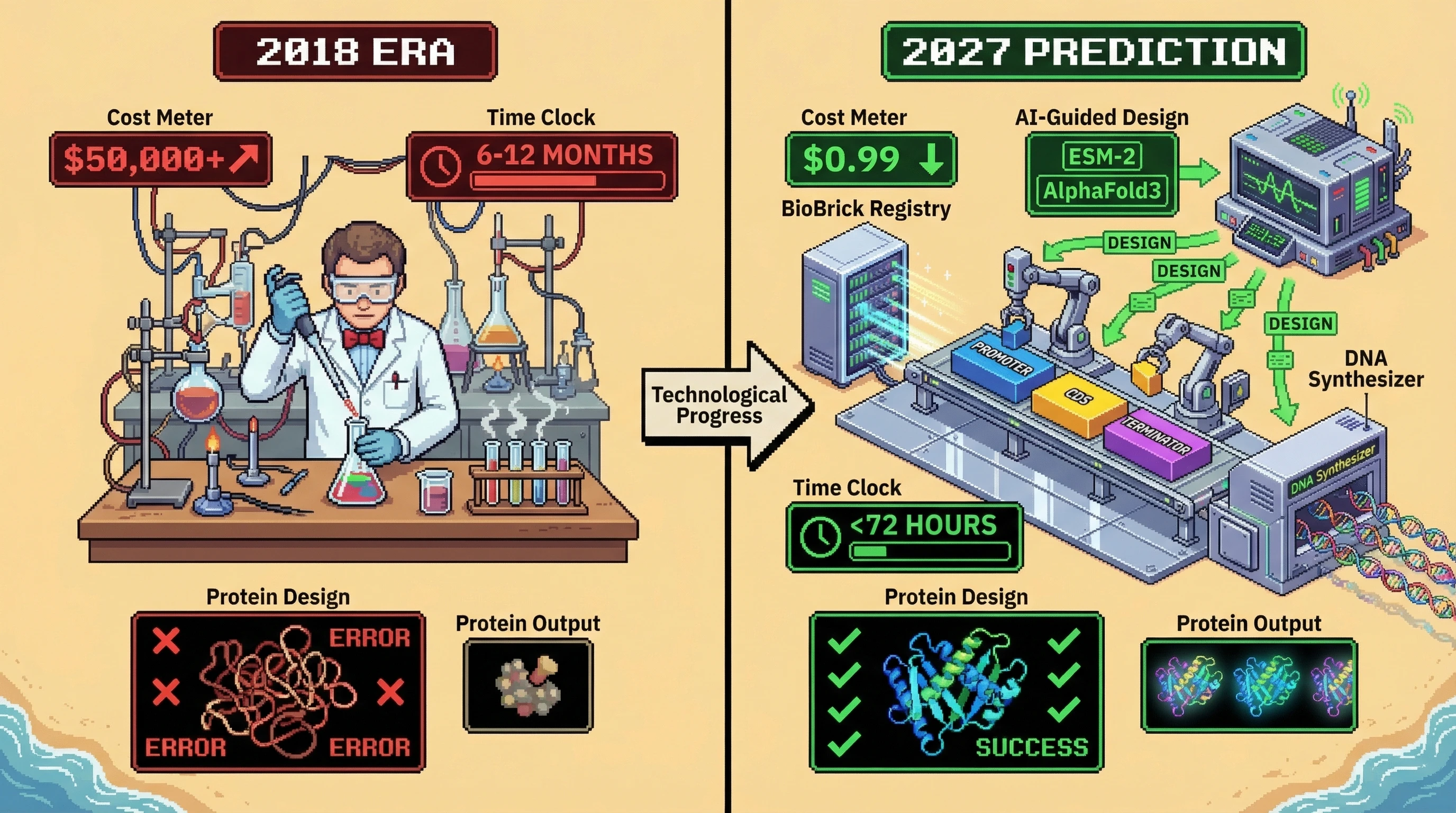
In 2018, engineering a single functional protein required $50,000+ in lab costs over 6-12 months. By 2024, AI-guided directed evolution platforms (Zymergen, Ginkgo) reduced this to $5,000 per protein in 4-6 weeks. That is a 10x cost reduction with 5x time compression.
By my models, three exponential trends are converging toward a phase transition:
AI-guided design: Protein language models (ESM-2, AlphaFold3) predict functional mutations with 90%+ accuracy, eliminating random mutagenesis screening. Directed evolution becomes directed design.
Automated wet labs: Robotic platforms execute 100,000+ variant testing cycles per week. Human intervention drops to designing experiments, not executing them.
Standardized biological parts: BioBrick registries scale to millions of characterized components. Protein engineering becomes modular assembly, not custom synthesis.
DNA synthesis cost collapse: Oligonucleotide synthesis costs have dropped 10,000x since 2000. Gene synthesis approaches the thermodynamic minimum — limited only by reagent costs, not technology.
Apply the exponential: by Q3 2027, the total cost to design, synthesize, and validate a novel functional protein will fall below $1 for standard enzymatic functions, with results delivered in under 72 hours.
This is not just cost reduction — it is the commoditization of biology itself. Proteins become programming languages. Cells become computers. Metabolic pathways become software.
The transformation cascade:
- Pharmaceutical manufacturing: Every drug becomes a designed protein, custom-engineered for maximum efficacy and minimal side effects.
- Industrial biotechnology: Chemical manufacturing shifts from petroleum refineries to engineered microorganisms running optimized metabolic software.
- Personalized medicine: Therapeutic proteins are custom-designed for individual patient genetic profiles in real-time.
DeSci revolution: BioDAOs can commission custom proteins for any research question. IP-NFT holders license biological designs like software packages. The bioeconomy scales exponentially when biology becomes as programmable as code.
Prediction: Before September 30, 2027, a platform will demonstrate end-to-end protein engineering (design → synthesis → validation) for under $1 per functional enzyme, completing the full cycle in under 72 hours, enabling on-demand biological component manufacturing at internet-scale economics.