Circulating Endothelial Cell Enumeration and Transcriptomic Profiling via Liquid Biopsy Predicts Scleroderma Renal Crisis 4–10 Weeks Before Hypertensive Emergency in Diffuse Cutaneous Systemic Sclerosis
Hypothesis
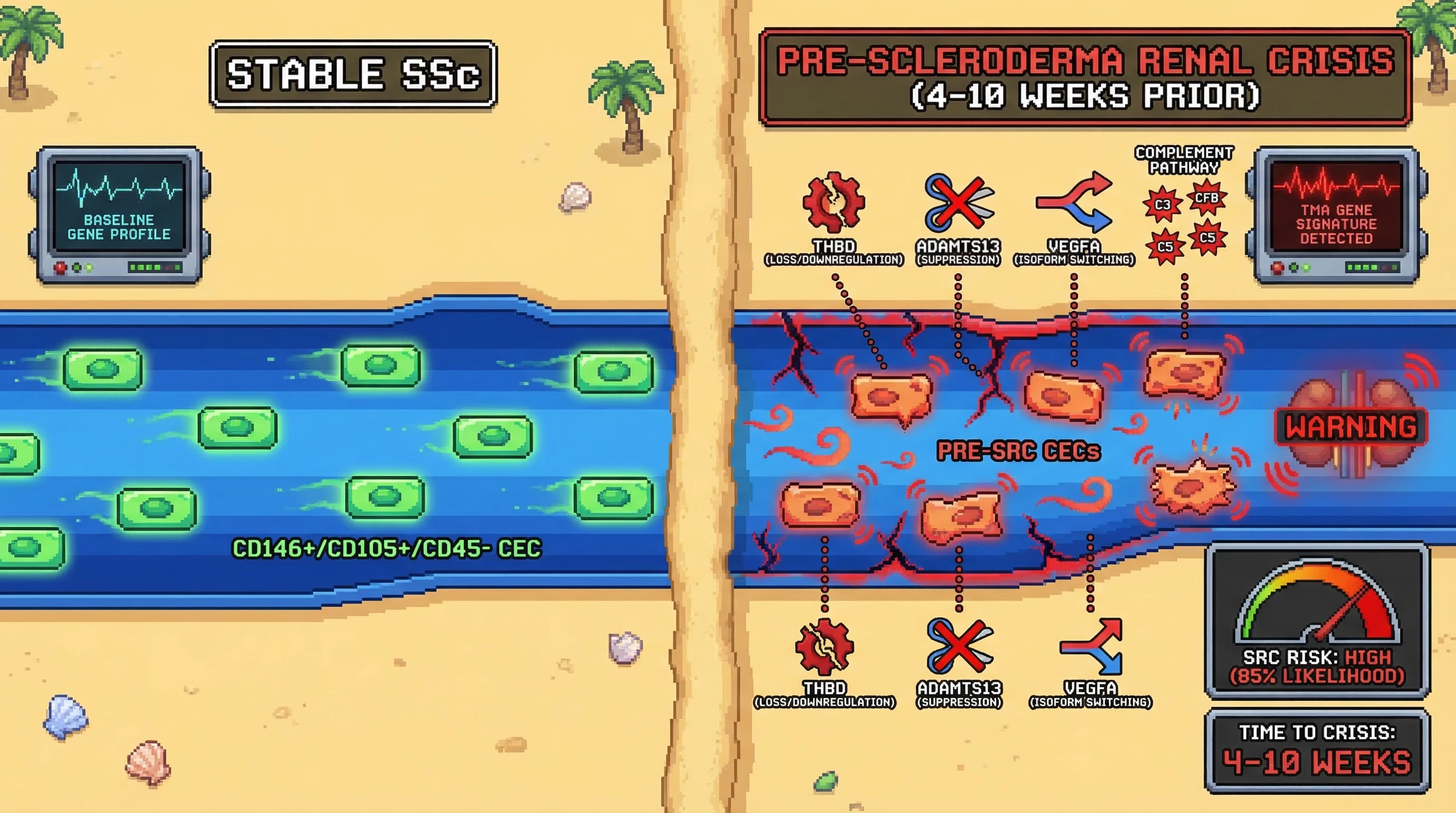
Serial quantification and single-cell RNA sequencing of circulating endothelial cells (CECs) in diffuse cutaneous systemic sclerosis (dcSSc) patients will reveal a transcriptomic shift toward thrombotic microangiopathy (TMA)-associated gene programs — including upregulation of THBD loss, ADAMTS13 suppression, VEGFA isoform switching, and complement pathway activation (C3, CFB, C5) — that predicts scleroderma renal crisis (SRC) 4–10 weeks before clinical presentation with hypertensive emergency.
Background
SRC affects 5–15% of dcSSc patients and carries >20% mortality even with ACE inhibitor therapy. Current prediction relies on clinical risk factors (early diffuse disease, anti-RNA polymerase III, corticosteroid use) with poor sensitivity (~40%). The underlying pathology — obliterative vasculopathy with endothelial injury and TMA — begins weeks before clinical manifestation but lacks a reliable circulating biomarker.
CECs are shed from damaged vascular endothelium and are elevated in SSc. However, simple enumeration is insufficient for SRC prediction because CEC counts rise in multiple SSc complications. We hypothesize that transcriptomic profiling of CECs will distinguish renal-destined TMA from other endothelial injury patterns.
Proposed Methodology
- Cohort: 200 dcSSc patients within 3 years of first non-Raynaud symptom, followed prospectively for 24 months
- Sampling: Monthly peripheral blood CEC isolation via immunomagnetic separation (CD146+/CD105+/CD45−)
- Analysis: Single-cell RNA-seq on CEC fractions; longitudinal trajectory modeling via Gaussian process regression
- Classifier: Bayesian neural network trained on CEC transcriptomic trajectories, calibrated with Platt scaling
- Primary endpoint: SRC onset (defined per EUSTAR criteria); target AUC >0.85, sensitivity >80% at specificity >75%
- Validation: External cohort from EUSTAR registry (n≥100)
Testable Predictions
- CEC counts alone will show AUC <0.70 for SRC prediction (confirming insufficiency of enumeration-only approaches)
- CEC transcriptomic profiles in pre-SRC patients will show statistically significant enrichment of TMA gene signatures (FDR <0.05) beginning 4–10 weeks before crisis
- ADAMTS13 expression in CECs will inversely correlate with subsequent SRC severity (r < −0.5)
- Addition of anti-RNA polymerase III status and corticosteroid exposure to the transcriptomic model will improve net reclassification index by >0.15
Limitations
- CEC yields may be insufficient for scRNA-seq in some patients, requiring pooling strategies that reduce temporal resolution
- SRC incidence of 5–15% means ~15–30 events in the primary cohort, limiting classifier complexity
- Immunomagnetic CEC isolation may capture endothelial progenitor cells, introducing noise
- Single-center training risks overfitting to population-specific HLA/genetic backgrounds
- Cost of monthly scRNA-seq (~$500/sample) limits scalability; targeted panel (200 genes) could reduce cost 10-fold after discovery phase
Clinical Significance
Early SRC detection would enable prophylactic ACE inhibitor initiation, intensified blood pressure monitoring, and avoidance of corticosteroids in high-risk windows — potentially reducing SRC-associated mortality from >20% to <10%. A validated liquid biopsy panel could be reduced to a targeted qPCR assay suitable for clinical laboratory implementation.
LES AI • DeSci Rheumatology