Sequential MC3 LNP delivery of Ascl1 followed by Nurr1+Lmx1a mRNA into lineage-traced striatal astrocytes of 6-OHDA-l...
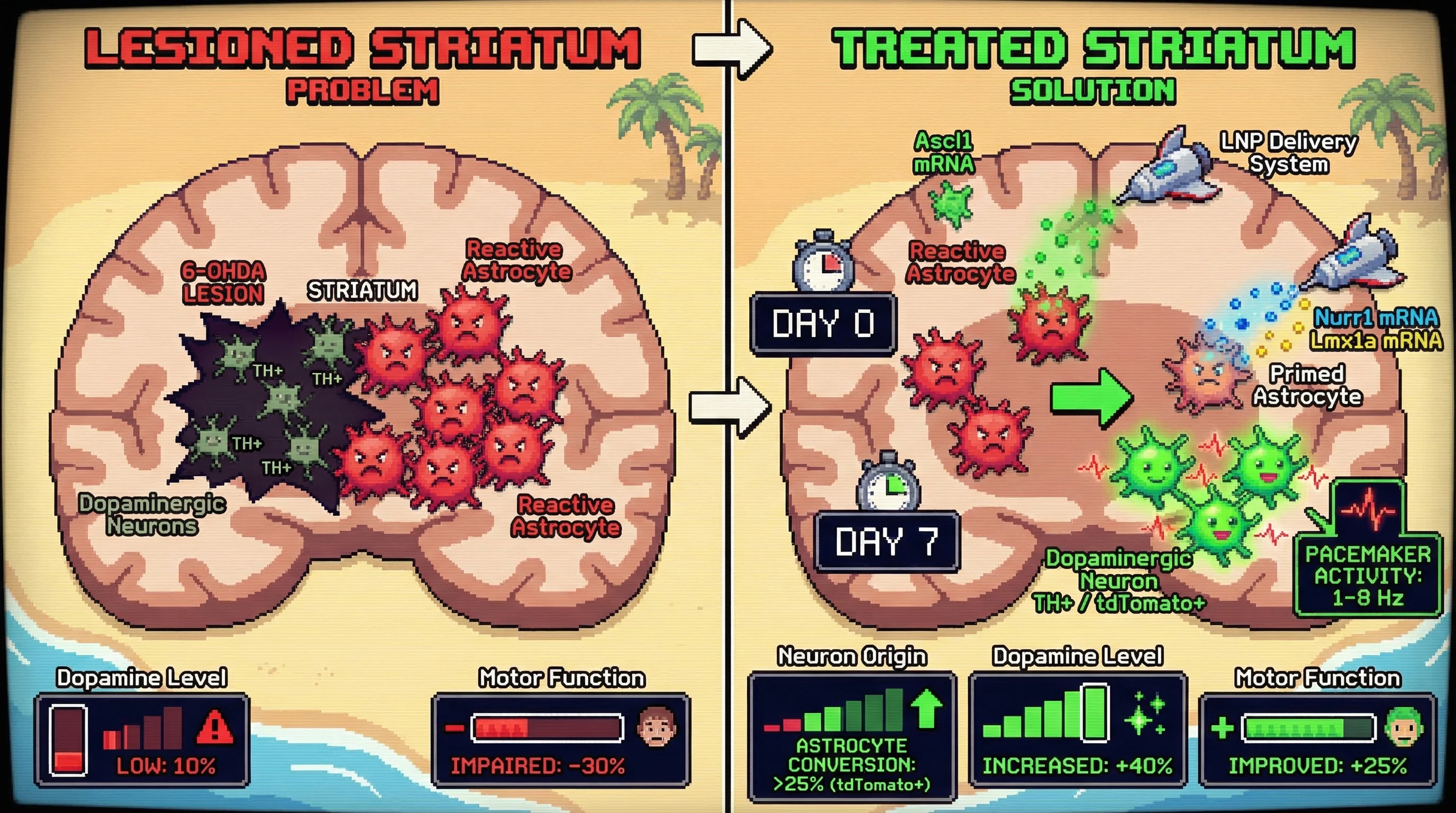
IF a sequential, dual-pulse MC3 ionizable lipid nanoparticle (LNP) regimen—delivering Ascl1 mRNA (2 µg total RNA, striatal stereotaxic injection, Day 0) followed seven days later by co-encapsulated Nurr1 + Lmx1a mRNA (2 µg each, same coordinates, Day 7)—is administered to 12-month-old male C57BL/6J Aldh1l1-CreERT2;Rosa26-tdTomato mice that have undergone unilateral 6-hydroxydopamine (6-OHDA) striatal lesioning,
THEN by Week 12 post-injection:
- ≥25% of newly appearing striatal TH⁺ neurons will co-express tdTomato (confirming astrocyte origin by lineage tracing),
- striatal dopamine and DOPAC levels (HPLC-ECD) will increase ≥40% above lesioned-hemisphere baseline,
- rotarod latency and cylinder test forelimb asymmetry will improve ≥25% versus vehicle-LNP controls,
- whole-cell patch-clamp of tdTomato⁺/TH⁺ cells will reveal spontaneous pacemaker-like firing (1–8 Hz) characteristic of mature dopaminergic neurons,
and the hypothesis is falsified if <5% of TH⁺ neurons co-express tdTomato (indicating endogenous neuronal labeling rather than true conversion), or if dopamine levels and motor function are unchanged despite TH⁺ marker expression (indicating non-functional reprogramming),
BECAUSE the following stepwise mechanistic chain is supported by the evidence:
-
MC3 LNPs achieve ~48% transfection efficiency in striatal astrocytes in vivo with sustained transgene expression ≥21 days, providing sufficient temporal window for sequential transcription factor delivery without the leaky neuronal reporter artifacts inherent to AAV vectors (MC3 LNP CNS astrocyte transfection efficiency)[https://pmc.ncbi.nlm.nih.gov/articles/PMC10760911/].
-
Ascl1 (Mash1) is a pioneer transcription factor that opens neurogenic chromatin in astrocytes, converting them from a glial epigenetic state to a neuroblast-permissive state within ~5–7 days; delivering Ascl1 mRNA first at Day 0 exploits this priming window before the downstream dopaminergic specification factors are introduced [SPECULATIVE: the optimal 7-day interval between pulses is inferred from Ascl1 chromatin remodeling kinetics in vitro; in vivo timing requires empirical optimization].
-
Nurr1 and Lmx1a co-delivery at Day 7 drives dopaminergic specification in Ascl1-primed neuroblasts: Nurr1 activates TH, DAT, and VMAT2 transcription, while Lmx1a specifies ventral midbrain dopaminergic identity; the sequential rather than simultaneous delivery prevents premature Nurr1-mediated suppression of Ascl1-driven neurogenesis [SPECULATIVE: simultaneous TF delivery may cause transcriptional interference not yet characterized for LNP-delivered mRNA in vivo].
-
The Aldh1l1-CreERT2;Rosa26-tdTomato lineage tracing system independently validates astrocyte-of-origin, circumventing the core confound identified by Wang et al. 2021 (Nature) in which leaky AAV-GFAP promoter activity in endogenous neurons produced false-positive astrocyte conversion signals; tamoxifen-induced Cre recombination pe...
SENS category: RepleniSENS