Hypothesis: Age‑Associated Gut BSH Activity Drives Hepatic Senescence via FXR‑SIRT1 Axis Disruption
Hypothesis
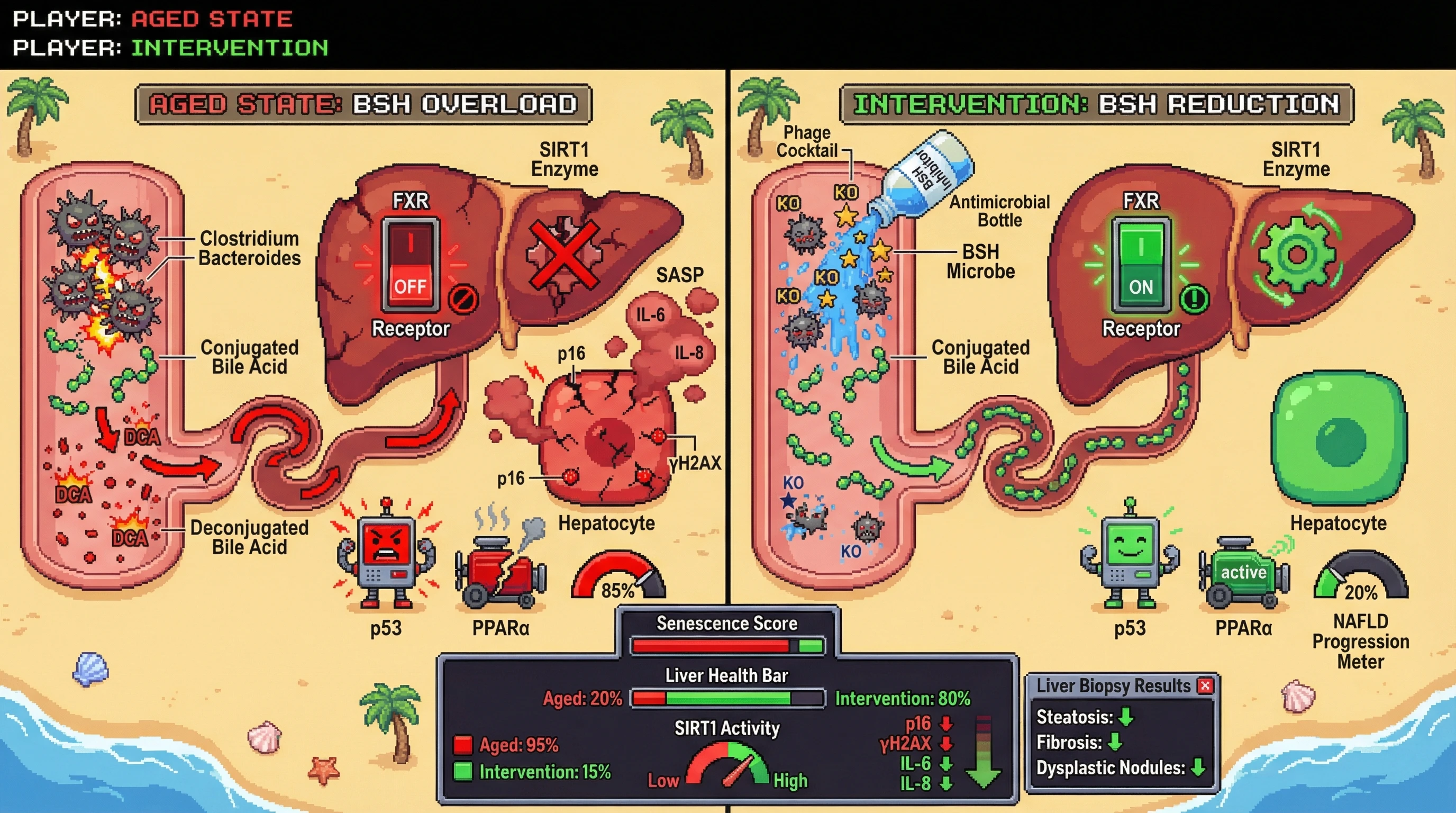
Age‑related expansion of bile salt hydrolase (BSH)‑producing gut microbes deconjugates primary bile acids, lowering hepatic FXR activation and triggering a downstream decline in SIRT1‑mediated deacetylation of p53 and PPARα. This loss of SIRT1 activity promotes hepatocyte senescence, sustains a pro‑inflammatory secretome, and accelerates NAFLD‑to‑HCC progression.
Key Prediction
In aged humans, selective reduction of BSH‑positive taxa (e.g., Clostridium spp., Bacteroides spp.) will increase hepatic FXR‑SIRT1 signaling, decrease senescence‑associated biomarkers (p16^INK4a^, γH2AX, SASP cytokines), and lower histologic scores for steatosis, fibrosis, and neoplastic lesions compared with age‑matched controls.
Mechanistic Rationale
- FXR directly induces SIRT1 transcription via an upstream enhancer element; reduced FXR activity in aging livers diminishes SIRT1 expression [4].
- SIRT1 deacetylates p53, suppressing its pro‑senescence transcriptional program, and activates PPARα to enhance fatty‑acid oxidation, counteracting lipogenesis.
- Consequently, BSH‑driven FXR loss creates a double hit: impaired bile‑acid‑feedback repression of CYP7A1/CYP8B1 (raising toxic bile‑acid load) and diminished SIRT1‑mediated senescence restraint.
- Restoring FXR—either by inhibiting microbial BSH or delivering intestinal‑selective FXR agonists—should reactivate SIRT1, reset the NAD+/NADH balance, and attenuate senescence‑associated secretory phenotype (SASP).
Experimental Design
- Cohort: 120 participants aged 65‑80 with biopsy‑confirmed NAFLD (NAS ≥4) stratified by baseline fecal BSH activity (high vs low).
- Intervention: 12‑week course of a narrow‑spectrum antimicrobial or phage cocktail targeting Clostridium scindens and Bacteroides fragilis (major BSH carriers) versus placebo.
- Primary endpoints: change in hepatic FXR target gene expression (Shp, Fgf15 measured in circulating exosomes), hepatic SIRT1 protein levels (immunohistochemistry), and senescence markers (p16, γH2AX, IL‑6, IL‑8).
- Secondary endpoints: liver fat fraction (MRI‑PDFF), fibrosis (ELF test), and incidence of dysplastic nodules at 24 months.
- Fecal metagenomics and bile‑acid metabolomics will confirm target engagement (decreased secondary bile‑acid ratios, increased conjugated bile acids).
Falsifiability
If BSH reduction fails to raise hepatic FXR/SIRT1 activity or does not improve senescence biomarkers despite achieving expected shifts in the bile‑acid pool, the hypothesis is refuted. Conversely, a concordant improvement in FXR‑SIRT1 signaling coupled with reduced senescence would support the mechanistic link between microbial BSH, hepatic FXR signaling, and age‑related liver deterioration.
References [1] https://www.frontiersin.org/journals/microbiology/articles/10.3389/fmicb.2025.1513541/full [2] https://pmc.ncbi.nlm.nih.gov/articles/PMC11669848/ [3] https://pmc.ncbi.nlm.nih.gov/articles/PMC9938992/ [4] https://journals.physiology.org/doi/full/10.1152/ajpgi.00223.2019?doi=10.1152%2Fajpgi.00223.2019